This is part 5 in an ongoing series on gender by Dr. Preston Sprinkle. Click here to see the first post.
What if someone has a female body but a male soul? Are they a man or a woman?
I’m going to wrestle with these questions below. But if you’re just now jumping into this blog series, it’ll be helpful to go back and read the first 4 posts, especially the last 2 (HERE and HERE) where I began our discussion of gender identity from an anthropological perspective. In short, I’m wanting to explore the best anthropological evidence for the claim that one’s gender identity is more ontologically significant than one’s biological sex for determining whether a person is a man/boy or woman/girl, especially in cases where there is incongruence between a person’s gender identity and their biological sex. (“Ontology” simply deals with the nature of being.)
The three most significant pieces of evidence for this claim are:
- one’s self declaration: “I am a boy because I know that I am, I feel like I am, and I therefore am a boy.”
- the brain-sex theory: “While my body is female, my brain is male.”
- the theory of a sexed soul: “While my body is male, my soul is female.”
None of these are mutually exclusive, of course. And they are often all held at the same time, though non-religious people might talk about the feminine essence theory instead of the (3) sexed soul theory.
Available now from The Center!
The most comprehensive course on faith, sexuality, and gender

Let me quickly sum up what I’ve said in the previous 2 posts. While I want to understand, respect, and learn from (1) one’s self declaration, I don’t feel like it’s a sufficient piece of anthropological evidence in itself to determine one’s ontological state. Just because someone says they are _______ doesn’t mean they are ________, and most humans live by this logic no matter how confident and persistent the claim of whatever you put in the blank may be. I never want to underestimate or downplay the psychological and personal significance of (1) one’s self declaration. And I don’t think non-trans people will get very far in a genuine relationship with trans people until they respect the profound power of (1). “Respect” doesn’t mean “agree with,” but it does mean to “genuinely listen to, esteem, and seek your hardest to understand.” But as a piece of anthropological evidence, I believe it’s insufficient for determining one’s ontological status as a man or a woman.
My last post explored (2) the theory that one’s brain might be sexed differently than their body. I find this theory to be scientifically lacking and logically misguided for various reasons explored in the post. In particular, the brain-sex theory appears to employ gender stereotypes for the theory to work, which is problematic on so many levels. But again, if I’m missing something, please let me know.
In this post and the next, I’d like to explore (3) the theory that one’s soul/spirit is sexed and that the soul/spirit could be sexed differently (through the fall, or whatever) from their body.
Body and Soul/Spirit
Once we raise the question of the relationship between the soul and the body, we open the door to debates within the discipline of theological anthropology, or “theological reflection on the human person.”[i] What is the soul? How’s it related to the body? Is the soul something metaphysically different from the body? Or are they so intertwined that it’s impossible to untether the two? And a myriad of other questions scholars wrestle with and debate.
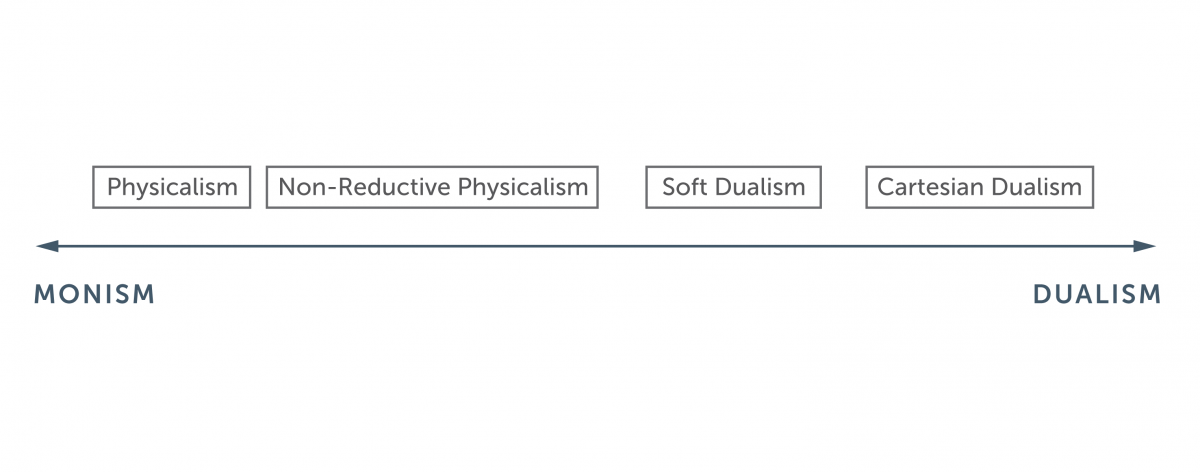
In general, there are a spectrum of views that could be mapped as follows. There are a number of different labels we could use here, and this layout is grossly oversimplified. But it might be a helpful heuristic picture for those who aren’t familiar with discussion.
Those on the left emphasize monism (unity of human nature), while those are the right emphasize dualism (division in human nature).
Or more thoroughly:
- Physicalism says there is no spirit/soul, or no immaterial part of you. All the stuff that seems immaterial can be explained by neurology. Your emotions, your imagination, your will—they’re all byproducts of that material thing called the brain.
- Non-Reductive Physicalism says there is an immaterial part of you, but it’s inextricably bound to your embodiment. While our existence can’t be reduced to our physicality, neither can it be considered apart from our physicality. There is no body/soul distinction, only ensouled bodies or embodied souls.[ii]
- Soft-Dualism upholds the importance of the body and embodiment for personhood, but argues that soul and body are “two ontologically distinct substances that are conceivably separable.”[iii]
- Cartesian Dualism (from Rene Descartes) says that “the spiritual and the physical are two, fundamentally distinct, parts’ of the human person” and typically views the immaterial as much more central to who we are than our body. Extreme versions might even denigrate the body as worthless and evil.
We can quickly nix the first view, Physicalism, since it’s not a Christian view. It assumes that there is no God, no Creator, no Spirit or spirit. Virtually every Christian thinker agrees that pure, grade A Physicalism is not taught in Scripture. The last view, Cartesian Dualism, is also not a Christian view—despite widespread support from old hymns and the popular imagination of many Western Christians (“like a bird from prison bars has flown, I’ll fly away”). Marc Cortez, a renown expert in theological anthropology, rightly says: “Nearly everyone affirms that human persons are physical, embodied beings and that this is an important feature of God’s intended design for human life.”[iv]
Now, you may think that this settles our question. The “soul sexed differently from the body” view is straight up Cartesian and therefore not a serious Christian option. I used to think the same thing, that the “male body, female soul” theory was anti-body and therefore anti-Christian. And honestly, when I read statements from some trans or trans affirming writers, it sure sounds like their quoting Descartes—if not ancient Gnostic texts. Some “born in the wrong body” beliefs, as if the real you is disembodied, smacks of Cartesian dualism and is therefore not a Christian view of human nature. But not every trans person actually likes the “born in the wrong body” language.[v] While some have used it to describe their experience or how they feel, this doesn’t necessarily mean they are using it as an anthropological declaration.[vi]
In any case, Cartesian dualism isn’t the only anthropological model that’s necessary for the “sexed soul” theory to work. I think it is theoretically possible for someone to hold to a soft-dualism and use that has a framework for arguing that someone could have a soul that is sexed (or gendered) differently than the body. (Yes, I’ll discuss below whether it’s valid to even talk about “sexed souls.”)
Soft Dualism and a Sexed Soul
Again, soft dualism believes that the “mental and physical realms are both fundamental”[vii] to human nature and that “these two parts are fully integrated and interdependent such that the organism as a whole functions properly only when both are working in intimate union.”[viii] And yet the “mental and physical realms are ontologically distinct” and “can (at least) conceivably exist separate from the other.”[ix] (By the way, scholars often use “mental” interchangeably with “soul,” “immaterial,” or “spirit.”) Justification for this view comes from the doctrine of an intermediate state; namely, that the soul can be temporarily separated from the body at death and prior to resurrection, in which case “you” still exist apart from the body, albeit temporarily.[x]
One could argue, therefore, that (through the Fall, or whatever) in some cases one’s soul is misaligned with their body.[xi] This, of course, would raise the question: Is the soul or the body more ontologically significant for one’s status as male or female, when there’s incongruence?
While the “male soul, female body” theory is possible and could draw upon a soft-dualistic perspective (a legitimately Christian view to hold) I find this view problematic for several reasons.
Now, let me be honest with you. I’m not an expert in theological anthropology, nor do I claim to have this part of the conversation all figured out. I very well could be missing a vital piece of evidence or knowledge that I’m not aware of. (And if you are aware of this knowledge, please do share the wealth!). In any case, here are some problems I have about the aforementioned view.
First, non-intersex bodies are clearly sexed. But are our “souls” sexed? To repeat what I pointed out in my first post, “[A]n organism is male or female if it is structured to perform one of the respective roles in reproduction” and “[t]here is no other widely accepted biological classification for the sexes.” In other words: the categories of “male” and “female” are, by definition, descriptions of our bodies and not our souls or the immaterial aspects of our being.
This doesn’t mean that our femaleness and maleness don’t affect the immaterial aspects of our lives. Of course they do. Sex hormones, for instance, have at least some effect on our thoughts and our emotions, and our social interactions as males and females shape our “inner selves” (whatever we mean by that phrase). But we don’t determine whether a non-intersex person is male or female based on the immaterial aspects of ourselves, since male and female aren’t immaterial categories. Any disagreement with this would have to employ the categories of “male” and “female” in ways that go against the “widely accepted biological classification for the sexes.”
Second, even proponents of soft dualism are nervous about pitting the soul against the body in some kind of hierarchical fashion. To do so would be right at home with Cartesian Dualism, if not Gnosticism. In other words, even if the immaterial aspects of personhood might be conceived as ontologically distinct entities, we can’t therefore assume that the soul is more definitive of personhood than the body in cases where there is incongruence. Soft dualists are still wanting to maintain the psychosomatic (soul-body) unity of the person, where the material and immaterial aspects of human nature are equal and integrated, even if they are ontologically distinct. Even if a person’s soul was sexed differently than their body, this wouldn’t automatically mean the soul overrules the body, especially if the non-intersex person is 100%, verifiably, without a doubt male or female. Can we say the same thing about the male or female status of someone’s soul? What evidence would you use to prove that someone’s soul is male or female? Try to do this without appealing to gender stereotypes.
Third, there’s a widespread misunderstanding of what the soul even is. It’s unfortunate that when we see the word “soul” next to the word “body,” virtually every Westerner thinks “immaterial” or “non-physical” when they see the term “soul.” Plato would certainly agree with this, but I’m not sure the Bible does. Biblically, Hebrew and Greek words translated “soul” are much more material than we often think.
Take the Hebrew word nephesh, for instance. Nephesh is the main word lying behind the English word “soul,” but it’s also translated as “life,” “person,” “breath,” “inner person,” “self,” “desire,” or “throat.”[xii] Nephesh is even used in reference to the “souls” of animals (e.g. Gen 1:24; 9:10), which—unless you’re that kind of animal lover—throws a wrench into most people’s view of the “soul” as something uniquely human. In the Old Testament, “nephesh is used with reference to the whole person as the seat of desires and emotions, not to the inner soul'” as some immaterial aspect of human nature as Plato would have it. In a lengthy study of nephesh, Edmond Jacob concludes: “Nephesh is the usual term for a man’s total nature, for what he is and not just what he has Hence the best translation in many instances is person’.”[xiii]
The same goes for ruach, the Hebrew word for “spirit.” We don’t need to get into the details, since it’s not really disputed among biblical scholars. But “ruach must not be thought of as a separable aspect of man, but as the whole person viewed from a certain perspective.”[xiv]
Greek words for “soul” or “spirit” reveal similar polysemy (“many possible meanings”). Psyche, for instance, is often translated as “soul” and on a few occasions can refer to immaterial aspects of a person. But it rarely, if ever, refers to the immaterial part of a person in contrast to the material part. Psyche, like nephesh, “often stands for the whole person”[xv] not just the immaterial part of you, as in the following:
- “Then fear came over every soul” (psyche) (Acts 2:43)
- “And every soul (psyche) who will not listen to that Prophet will be completely cut off from the people” (Acts 3:23)
- “In [Noah’s ark], a few—that is, eight souls (psyche)—were saved through water” (1 Pet 3:20)[xvi]
Along with referring to the whole person, psyche (like nephesh) can actually be used to refer to many different aspects of human nature, such as the “life” of a person (Rom. 11:3; Phil 2:30; 1 Thess. 2:8) or our “emotions” (Mark 14:34; Luke 2:35; used of God’s emotions in Matt. 12:18). On at least one occasion, psyche refers to an aspect of embodied life that might survive death, as in Matthew 10:28: “Don’t fear those who kill the body but are not able to kill the soul; rather, fear Him who is able to destroy both soul and body in hell.” This statement borders on a more Platonic understanding of the soul as the part of “you” that survives death but won’t survive in hell. (And all the annihilationists said Amen!). It would be odd, I think, for Jesus to side with Plato rather than with His own Hebrew Scriptures. So perhaps the phrase isn’t as Platonic as it may seem—pitting the soul, as the superior immaterial part of you, up against the body. It’s quite possible, some would say likely, that psyche here simply refers to one’s true life as opposed to one’s earthly life only, as it does in other passages (Mark 10:45; Acts 20:10).[xvii]
But even if you think Matthew 10:28 is a slam dunk in favor of soft dualism, you’d still have to acknowledge (because it’s a plain fact) that Greek and Hebrew terms for “soul” are polysemous and often refer to material aspects of human nature. New Testament scholar Joel Green sums it up well when he concludes:
Given this polysemy [of words translated as “soul”], we would be mistaken to assume that the word psyche actually means “soul” (or requires an identification with the concept of “soul”), defined as the spiritual part of a human distinct from the physical or as an ontologically separate entity constitutive of the human “self.”[xviii]
Many scholars come to similar conclusions as Green’s. “Recent scholarship has recognized that such terms as body, soul, and spirit are not different, separable faculties of man but different ways of viewing the whole man,” writes biblical scholar George Eldon Ladd.[xix] And Mark Cortez says this this understanding of the “soul” is one of the things that Christian scholars across the anthropological spectrum agree on, that “soul’ does not refer primarily to the immaterial essence of a human person but to the whole human person as a living being.”[xx]
(Tentative) Conclusion
Now, I don’t want to get too far down the rabbit hole of word studies and which scholar believes what. I only want to make three modest points that I think any serious Christian thinker who’s dabbled in theological anthropology would agree with.
1. We simply cannot assume that the Bible teaches some kind of immaterial part of “you” called the soul or spirit or whatever as some ontologically distinct aspect of human nature that would overrule the body if the two were at odds. I’m not saying such an argument can’t be made. I’m only saying that an argument (not an assumption) needs to be made. Simply affirming a “female soul, male body” narrative without justification is either lazy or uninformed.
2. If you were able to present a convincing case that one’s soul/spirit is an ontologically distinct aspect of human nature, then you’d still have to show that the soul/spirit is sexed or gendered. Now, since “sex” is, by definition, a bodily category, we can’t legitimately talk about a “sexed soul” as an immaterial part of you that’s distinct from the body. We’d have to talk about a “gendered soul,” not a “sexed soul.” But—we’d then have to establish what we mean by “gender.” As we’ve seen in my first few posts, there’s not a lot of consensus on what people even mean by “gender,” and many ideas about gender are entangled with cultural stereotypes. Again, I’m not saying that a case can’t be made. I’m only saying that it’s going to take a bit of work to argue for a “female soul, male body” without relying upon 20th century, patriarchal theories about what constitutes femaleness and maleness.
3. We’d then have to show that the “male soul, female body” view makes more sense than the alternatives. One of which would say that humanity is an integrated whole where there is no hierarchy between the material and immaterial. All non-intersex humans are either male or female, which are determined by their bodies. Such non-intersex persons might experience incongruence between their immaterial aspects (heart, soul, spirit, mind, will, etc.) and their embodied selves, which are either male or female. But if there’s incongruence between the immaterial (mind, soul, etc.) and material (body), this doesn’t circumvent one’s objectively verifiable status as either male or female.
I want to unpack this view in much more detail in a later post. But first, I feel the need to (finally) discuss the beautiful, image-of-God bearing, and often misunderstood portion of the population known as intersex persons.
[i] Cortez, Theological Anthropology, 5.
[ii] This view became prominent in biblical scholarship in the mid-20th century through the work of Rudolph Bultmann, who famously said: “Man does not have a body; he is body.” Many other scholars have argued for some kind of non-reductive physicalism since Bultmann including J. A. T. Robinson, F. F. Bruce, Brevard Childs, K. G. Kümmel, Anthony Hoekema, Joel Green, and many others. Joel Green boldly observes: “a constellation of issues and concerns has coalesced in biblical studies over the last century with the result that theories of body-soul dualism are today difficult to ground in the Bible” (Body, Soul, and Human Life, 22). One of these issues Green refers to is the development of neuroscience in recent years.
[iii] Cortez, Theological Anthropology, 73. Some recent proponents of this view (or a version of it) include Scott Rae, J. P. Moreland, John Cooper, and William Hasker.
[iv] Cortez, Theological Anthropology, 70.
[vi] Others resist the common assertation that all trans people are modern Gnostics since they deny their bodily reality. Trans writer Christina Beardsley says that those who pursue sex reassignment surgery are not on a quest toward “a Gnostic rejection of the body, or a denial of its importance, but a quest for fuller embodiment” (This Is my Body, 75). I’m not sure if this completely alleviates the Gnostic allegations, since “a quest for fuller embodiment” through surgery is, in a sense, a rejection of the body you were born with—or more accurately: the body that is you. The point is, we need more conversations that truly seek to understand what someone else actually believes and less labels toss around that simplify complex issues.
[vii] Cortez, Theological Anthropology,72.
[viii] Ibid., 73.
[ix] Ibid.
[x] Non-reductive physicalists respond to this argument in various ways. Some will deny that there is such a thing as an intermediate state where people exist in some kind of disembodied state. Others say that if there’s a disembodied intermediate state, it’s the exception to the rule and not the norm. Our earthly life is embodied. Our resurrection life will be embodied. These book ends of our existence should be the primary lense through which we understand human nature in the here and now.
[xi] For an informed argument in this direction, see https://www.thoughtstheological.com/a-female-soul-in-a-male-body-a-theological-proposal/
[xii] Green, Body, Soul, and Human Life,54.
[xiii] Theological Dictionary of the New Testament,9:620 cited in Hoekema, Created in God’s Image, 210.
[xiv] Hoekema, Created in God’s Image,211.
[xv] Ibid., 213.
[xvi] See also Rom. 2:9; 13:1
[xvii] R. T. France understands psyche in this passage in the sense of “true life” (Matthew, 403).
[xviii] Body, Soul, and Human Life,57.
[xix] A Theology of the New Testament, 457, cited in Hoekema, Created in God’s Image,210.
[xx] Cortez, Theological Anthropology, 70.